Toward New Light, Carried in Sound

I love being introduced to new music by friends. It feels like a gift—especially when it becomes something you can share, unpack, and return to together. Not just the sound, but the lyrics, the intent, the meaning behind it all.

My friend Arthur recently introduced me to VNV Nation—“Victory Not Vengeance.” That ethos isn’t just a name; it’s embedded in Ronan Harris’s lyrics and perspective in a way that feels grounded, intentional, and deeply human. Ronan is the frontman and founder of VNV Nation.

I’m honestly surprised I hadn’t come across them before. Given my leanings toward techno and adjacent genres, you’d think our paths would have crossed sooner, but I haven’t spent as much time in industrial or EBM spaces, and somehow they passed me by.

What I do know is this – I’m glad I’ve been introduced and that they didn’t pass me by.

I’ve put together a playlist of tracks that have really landed with me—not just because of the production, which is absolutely outstanding, but also because of the emotional weight carried in the lyrics.

Listening to VNV Nation—and to Ronan speak about his work—has made me reflect on my own music as Polyatomic.

There’s a parallel there: the idea of creating from a place of honesty, of putting emotion into the music first, writing from the heart and letting everything else follow. If it resonates, it resonates. Exploring different styles and inspirations for our albums.

I’m going to be heading into production on my fifth full-length studio album and I admit, I’d can feel a pull to go in a Futurepop direction and while I don’t have the hardware list that VNV Nation has, I have more than enough to carve out my own interpretation of that sound.

In some respects, I’ve already brushed up against it. Take a listen to my Techknow album, there are hints of that direction—ideas that could be further refined. I wrote that album as a thank you to time I’ve spent in Berlin, and also a chance to decompress with something looser, more exploratory and less concerned with polish after releasing Icebergs which was an intense and emotional production and body of work.

Incidentally, Techknow was heavily hardware-based too.

I’ve always gravitated toward strings, pads, and piano—layering in an acid line here and there, building something cinematic, sometimes trance-like. I say I’ve never really identified with harder-edged electronic styles in my body of work, but honestly, you can hear there’s something that’s been waiting to be released and I’m ready to go there, to really explore.

And I think VNV Nation has shown me you can take an album like Strength, add harder elements and create thoughful and joyous music that takes a listener on a journey.

This feels like a natural evolution rather than a departure and it’s something I want to explore more intentionally.

I know I’m on the right path with Polyatomic and what I want it to represent, the emotion that project conveys.

I’ve always said my next album was likely to be called Hardware and feature more of my hardware as I’ve been heavily soft-synth oriented. I really do want to explore analogue synthesis more, which I think will take me more in an experimental direction. I’ve been mulling other titles as well given recent events in my life that I know will greatly impact the sound of my next album.

Arthur and I are going to see VNV Nation live in Toronto, in May. I’m really looking forward to sharing that experience—with him, with the crowd, and with music that, in a short time, has already become something quite personal to me.

My first music video drops tomorrow for Terra Nova which was released on Icebergs, finally getting a video treatment it was supposed to receive years ago.
Changes coming for my YouTube Channel

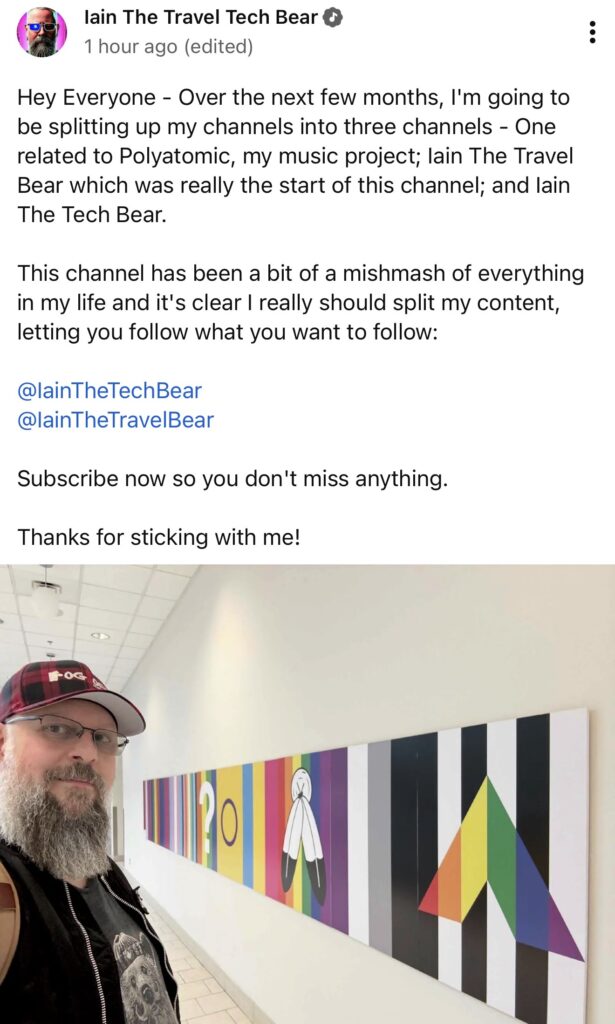
In 2019, I started creating content on YouTube documenting my year of living in the UK and spending time in mainland Europe.

The pandemic hit and I’ve not been travelling as much, so I decided to start some tech content.

While I’m not travelling as much, I think it’s going to be important to split my content into three different channels:

That way you get to see and subscribe to the content you want to follow, and that will also likely help “the algorithm” direct people to the correct content.

For the next few months, I’ll be transitioning content to their respective channels posting videos weekly

Iain in Halifax YHZ

What is my history?

As I reflect back on the 33-year search for my biological parents which now draws to a close, it opens a different door entirely – What is my history?

Adopted kids lead interesting parallel lives of sorts – We inherit the life story of those who adopted and raised us – their history becomes our history.  Their traditions, their stories, their sense of where they come from all shape who we become.

Depending on the age at which we were adopted, that’s the only history we’ve known or it takes a fork in the road.  

In my case, I was adopted at three and a half months old, so I only knew one history until twenty-two years ago and then six months ago at the time of this writing.

For others who were adopted later, there can be memories of a life before adoption. Their histories may feel even more parallel — two lived experiences running side by side.

I can only write from the perspective of someone that was adopted as a baby.  For me, the question has never been about replacing one history with another.

The truth is simpler and more complex at the same time – both are mine.

I grew up with the stories of my adoptive family — their struggles, their humour, their values. Those stories shaped me. I was inspired by my adoptive parents, guided by them, and molded by the life we shared.

That was real history, and it was foundational for who I’ve become.

At the same time, learning the limited history of my maternal side — and especially the deeper, wider history of my paternal side — has opened another dimension of understanding. There is a long line of people whose lives, choices, resilience, and circumstances also lead directly to me.

I didn’t grow up in that world, and I didn’t inherit its traditions in the same way.

But discovering it has brought a sense of recognition — a deeper appreciation for where some of the threads of my life began long before I was here to see them.

There is pride in that history, even if parts of it are still unfamiliar.

And maybe that’s the point.

History, for someone adopted, isn’t a single straight line. It’s more like a braid — different strands woven together over time.

One strand is the life you were given. Another is the life you came from.

And somewhere in the weaving of those strands is the place where you finally begin to understand your own story.

As an adult, I’ve always been comfortable moving between different environments — from boardrooms to kitchen tables and communities. I’ve always been curious about people, cultures, and different ways of living, often trying to see the world from someone else’s perspective. In hindsight, I wouldn’t be surprised if that instinct was shaped by being adopted. Now, as I begin integrating this newly discovered part of my life, that instinct takes on a whole new depth.

Integration, for me, isn’t about choosing between worlds or rewriting the past. It’s about allowing these histories to sit beside each other and recognizing that both have shaped who I am. The family who raised me gave me my foundation — the values, lessons, and stability that shaped my life. The family I have come to know more recently adds something different – context, connection, and a deeper understanding of where some of those threads began long before I was aware of them.

Identity isn’t a replacement process. 
It’s an expansion. 

Each new story, each shared memory, each moment of recognition simply adds another layer to the life that was already there.

Neither history stands alone. Together they form the fuller picture of who I am.

Back to my roots

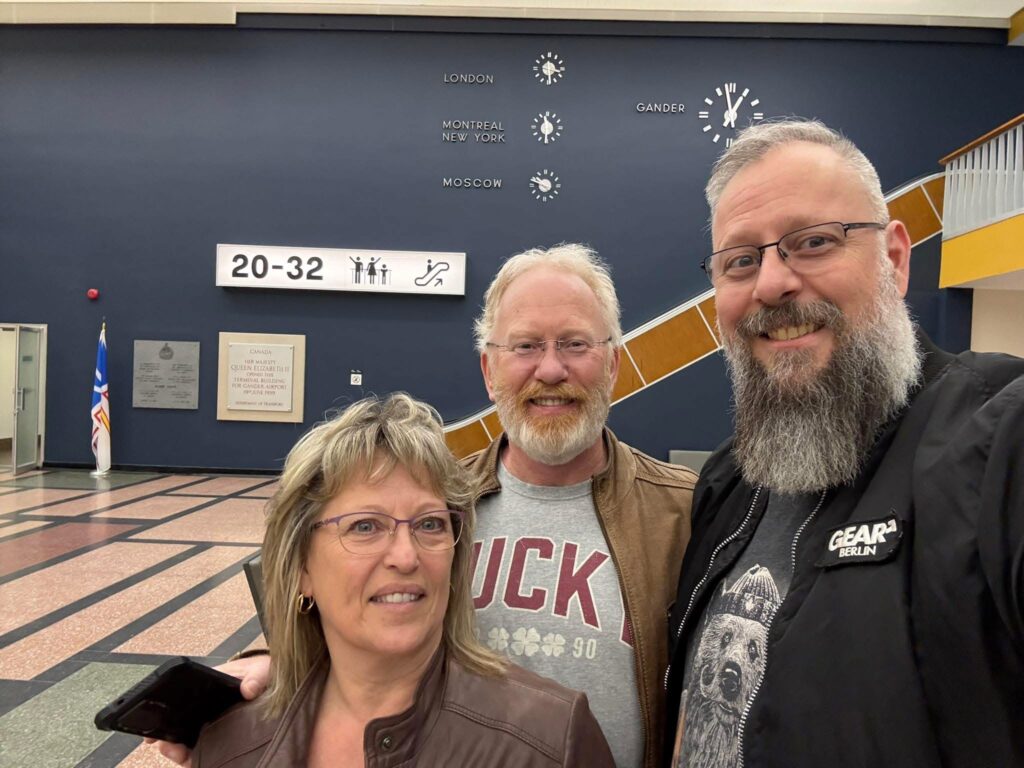
This past weekend I flew to Gander, Newfoundland and Labrador to spend time with my sister and her family. My brother flew out to connect with us.

During the trip I also got to meet 4 aunts, a grand-aunt and 9 out of 28 cousins that I counted when going through the family tree with Karen. Talk about mind blown on just that point.

I don’t talk a lot about my spirituality, but I firmly believe that at times I’ve felt a guardian angel looking over me. For example, when living in Frankfurt, Germany in December 1995, I was feeling so disconnected from family and friends, and the emotions of that – it was like something was telling me to get back to London where I had family. I did get back to London to find on Christmas Day my father had passed away.

I’ve put in a lot of work on myself over the past 6 years, and even broader than that, the past 23 to 26 years between therapy, self help, courses, and mentors – it’s like the universe saying, “You’ve done good b’y, here’s your family and they’re awesome, now go and connect, enjoy and feel the love.”

I know it doesn’t work that way, or maybe it does. Who knows? Karen, Kevin, and the rest of our family have come into my life at the perfect time.

I could not have asked for a more perfect weekend of connection, getting to know each other, and bonding. The love everyone has shown me has been amazing and I hope everyone knows it’s returned in spades.

My heart is full and bursting about how the two of us have bonded. Having an older brother like Kevin who shares similarities to me – sensitive, pragmatic, humourous, smart – has me elated. Having an older sister who values connection and family, smart, straight up, who has taken the time to truly get to know me, who reaches out, who took me under her wing this weekend to introduce me to a bunch of stuff I hadn’t experienced before – I could not ask for a better older sister and that has been super healing for me.

I’ve never experienced that level of connection from siblings – ever. Maybe in our early days with Robyn. I said to my aunt (one of my aunts, now? LOL!) and two of my cousins – I have no idea where Robyn and I went wrong as I search within myself. The overwhelming response was, “It’s not on you at all. You both had a messed up childhood and the fact that you came out of that a great person is a testament to your strength.”

I feel it, and not only do I feel seen after years of being afraid to show my light, years of being afraid to speak up, ask, to be validated.

I wish Robyn and I had a much better connection than we do, I think the odds were stacked against us from the beginning for a number of factors I won’t go into. I will say this, I don’t think she had the space nor the permission to just be and to find herself and I hope, very much hope she is able to find herself and heal to the best of her abilities. She deserves light, love and happiness. I have always felt this despite the friction between us.

There are so many people who are no longer with us that I wish I could share in this moment.

  • My adoptive dad who would have been super proud of all of us,
  • Scott’s mum, Betty, who was so instrumental in showing me what family was and accepting me in to her family, her consistency and love,
  • Our dad who, I don’t know if he’d be shocked or not, but I know he would be elated and proud of my accomplishments and I know, if he’s present spiritually in our world and if he were still living today, that he would be proud of Kevin and Karen for how they have embraced me.

I also wish my adoptive mum and sister could witness this moment with grace and appreciation, putting themselves in my shoes for once. Enough said there.

There is once person I do want to acknowledge and that is Kevin and Karen’s mum, Joyce. I appreciate her willingness to be present with all of us this past weekend. She is amazing.

Newfoundland is beautiful – the land, the people, the wildlife – all of it. We have some amazing unique traditions and way of life, some of which does parallel rural areas in other areas of Canada but it is still unique. For many, this is how Newfoundlanders survived the challenges of that environment.

I have always hated winter and cold weather. This weekend had me embracing winter in a way I haven’t in forever if ever. So much so, I’m ready to head to Bass Pro Shop next winter and get a pair of snow pants – it would be “weird” to see here in Toronto but it would help me embrace winter more.

I can’t wait to get back to Newfoundland this summer. I don’t have a date yet given Scott is headed into knee replacement surgery season with his first surgery taking place on April 21st and second one in July. I am hoping Scott could come with me but it may have to wait until next year.

I have a lot of Newfoundland content coming up on my YouTube channel. It’s part of me returning to own what was always mine. The first video is up, about the International Lounge at Gander International Airport.

This song, Where there is light by VNV Nation (VNV for Victory not Vengeance) speaks volumes about how I’m feeling right now and has been playing through my head. Ronan’s music, his lyrics and what he sings about hit home for me.

A Sunday Discussion

I’m writing this Monday evening, and I’ve been feeling raw today.  Not in a bad way, but in a “wow that was an amazing weekend”, that has left me fulfilled.

Specially Sunday, I spent some time with someone new.  We’ve been having some really deep conversations about gay men’s mental health (although the themes are not totally unique to the gay community), specifically about how we’ve both dealt with anxiety, baggage, emotions, the importance of expressing them and the divide between older men and us –  how that past generation on occasion dismisses mental health, how we realised that it needs to be dealt with, how we see and have experienced how it manifests and how we encourage that in others.

This is not an us against them post – there’s no value in that kind of division that you see in mainstream media all too often.  Instead, this is about our observations and experiences.

I really do believe men need positive reinforcement that it’s okay to feel and have emotions, and not just permission.

Times are changing. Many of us were never really taught how to sit with anxiety without calling it weakness. We weren’t shown how to talk about shame without deflecting it with humour, sex, anger, or achievement. A lot of us were handed a model that said: be strong, be desirable, be successful, don’t be complicated.

For gay men especially, there’s an added layer. We learned early how to code-switch, how to scan rooms, how to measure safety, how to make ourselves acceptable. That vigilance doesn’t just disappear because we come out. It buries itself in our nervous systems. It shows up as overthinking, perfectionism, sexual anxiety, as the need to be “at our best” all the time.

We talked about how some older folks were taught to push it down. “Don’t talk about it”, “Be grateful”, “Other people have it worse”, “Stop playing games”.

I don’t say that to criticize them — I say it because that was survival for them. Emotional restriction was a coping strategy in a generation that didn’t have language or containers for mental health.

I’ve lived and experienced some of those moments from older folks – men and women – whether directed at me or when talking about others “Turn off the water works”, “They’re playing games”, “Man up”, plus other statements.

In the discussion this weekend, we both feel we straddle something different. We got the emotional shutdown messaging, and then we also got access to therapy, self help culture, psychology books, online spaces, community dialogue, new research. We almost feel like a bridge generation that feels everything from both sides.

What struck me most on Sunday was this and I was re-reminded: when two men choose to speak plainly about anxiety, about fear of inadequacy, about breakdowns, about survival mode – there’s a real shift that happens and I find that candour really refreshing. There’s less performance, less bravado and more quiet honesty.

That is strength.

Positive reinforcement between men is radical. Saying:

  • You handled that well
  • That anxiety makes sense
  • You don’t have to carry that alone
  • You’re allowed to rest
  • You’re worthy even when you’re not performing

This rewires things.

We cannot keep expecting men to magically be emotionally regulated while simultaneously shaming them for having emotions.

Yes, some men avoid this work, mocking it, hiding behind cynicism – dear $deity have I seen this in spades! That’s part of the story too. 

Growth isn’t universal or linear, and it’s not always tidy – I know this all too well.

Avoidance is often armour, cynicism is often protection, defensiveness is usually fear wearing a sharper jacket, projection is pain looking for somewhere else to land.

Regardless, every man is worthy and deserving of connection, love, and of a life that feels integrated and whole. Worthiness isn’t contingent on courage, curiosity, or timing.  Integration isn’t something you earn by getting it “right.” It’s something you grow into at your own pace.  No one is outside of that possibility.

Feeling deeply isn’t fragility – it’s integration, and integration is available to all of us, whenever we’re ready to turn toward it.

If we want healthier relationships, healthier sexuality, healthier leadership, healthier friendships — men have to do this work. Not perform it, not posture it, actually do it.

We have to look at our anxiety, our anger, our shutdown patterns, our shame around desire, our fear of aging, our fear of not being enough.

We have to stop pretending we’re above needing each other.

Sunday left me raw in the best way – connected, expanded.  It reminded me that vulnerability between men isn’t emasculating. It’s liberating.

If you’re a man reading this:
Your anxiety is not a character flaw.
Your past coping strategies were survival.
Your breakdowns don’t disqualify you.

And you don’t have to do this alone.

P.S: This entry has been at least 32 years in the making. I’ve been carrying these thoughts since first-year university. I’m grateful it’s finally out of my head — and that life has given me the experiences to understand what I was sensing and questioning back then.

The past in 5.25in floppies

Over the holidays, my Commodore 64 Ultimate arrived. For those that don’t know, Commodore is back and they’re back with a very awesome and true to the classic FPGA-based Commodore 64.

It’s absolutely brilliant. It supports old peripherals, new peripherals, USB storage and the ability to plug in two original SID chips, among other things.

I’ve been spending time backing up disks over the past two or three years. There was a stall as my childhood C64 died – although I think it can be revived by replacing RAM chips based on the behaviour. That’s where the C64U is absolutely brilliant.

So I’ve been going through a bunch of of disks – mostly full of games, some old high school assignments, and some treasures from friends from my past who are no longer with us, but programs they had written themselves.

Despite having these disks for a long time, I never ventured into some of the other programs – assuming it was all data for a particular game. It turns out some of these were basic programs that were written by these two friends in particular.

I’ve often thought about them, but having something somewhat tangible, in the form of a 5.25in floppy, with something they likely enjoyed writing – adventure games, some rudimentary character-based animations, it was really neat to see.

It definitely had me wondering what would have happened had they both been around today, what lives they would have lead. Both were creative individuals – one an amazing pianist, the other into drawing, and both had imaginative minds.

What strikes me is, no one other than the two people I’m thinking of would appreciate the code that I found beyond me, maybe one of their brothers. They’d have been lost to time had I not thought – “Lets see what this is”.

It was a neat way to remember two people lost way too soon.

I made backups so they’re immortalized on USB, soon my file server, and also my retro gaming setup. Preserved that little while longer, honouring them both with code they wrote 41 years ago at the height of the 8-bit computing era.

What We Mean When We Say “Safety”

When people talk about safety, I’m feeling that we usually think of it in very narrow terms, such as the following:

  • Physical harm,
  • Rules,
  • Boundaries,
  • What’s “allowed” and what’s not.

Those things matter, but they’re a baseline and somewhat obvious.

As I’ve been figuring out my path over the past few years and sort myself out, I’ve realized there’s a much deeper nuance we might be tippy toeing around. We know it’s there, we just don’t bring it to the forefront of thought.

I’d like to talk about safety especially in the context of belonging — I’m talking about something broader and quieter. Something most of us feel instinctively but rarely name.

Safety is what allows a person to stay.

Safety Is Not the Absence of Harm

Safety isn’t just the absence of violence or overt cruelty.

A room can be technically “safe” and still feel hostile.

A group can follow every rule and still make people shrink.

A space can say everyone is welcome and quietly punish those who test that claim.

Real safety isn’t about what doesn’t happen.

It’s about what does.

What People Are Scanning for When They Enter a Space

When someone walks into a room — especially someone who has been marginalized, traumatized, or repeatedly excluded — they are scanning constantly. I know I do, subconsciously, asking questions like:

  • Am I welcome here, or merely tolerated?
  • What happens if I say the wrong thing?
  • Will I be ignored, corrected, mocked, or dismissed?
  • Who seems relaxed, and who seems guarded?
  • Is attention given freely, or does it come with a cost?
  • What happens when someone is vulnerable?
  • Do people stay consistent, or do rules change depending on who you are?

This isn’t paranoia. It’s pattern recognition.

People learn very early what it costs them to be visible.

Safety Is Predictability

One of the most important and underrated components of safety is consistency.

People feel safer when:

  • responses are predictable
  • kindness isn’t revoked without explanation
  • boundaries are clear and stable
  • feedback doesn’t come wrapped in shame
  • affection doesn’t suddenly disappear

You don’t have to be perfect to be safe. but I propose you do have to be reliable.

Inconsistent warmth is one of the fastest ways to make a space feel unsafe.

Holding Space Is an Active Practice

We often talk about “holding space” as if it’s passive. It’s not.

Holding space means:

  • letting others take time without rushing them
  • allowing discomfort without trying to fix it
  • resisting the urge to center yourself
  • noticing who hasn’t spoken — and why
  • not punishing people for being careful
  • not demanding performance as proof of belonging

Holding space doesn’t mean lowering standards or abandoning boundaries.

It means enforcing them without humiliation.

Safety Is About Not Making People Earn Their Right to Be There

Many spaces claim to be inclusive but quietly expect newcomers to prove themselves.

To be confident enough. Interesting enough. Resilient enough. Easy enough.

That’s not safety — that’s audition culture.

Safety exists when people don’t have to minimize themselves, overperform, or apologize for taking up space just to remain welcome.

Why Safety Comes Before Belonging

Belonging is often framed as something people should choose. I have argued in previous posts that choosing belonging requires safety first.

Without safety:

  • the nervous system stays alert
  • risk feels dangerous instead of exciting
  • connection feels temporary
  • withdrawal feels like self-protection

People don’t fail to belong because they lack courage.

They struggle because safety hasn’t been established yet.

What It Looks Like to Create Safety

Creating safety doesn’t require special training or perfection. It looks like:

  • saying hello and meaning it
  • following through on what you offer
  • being clear instead of clever
  • naming mistakes without shaming
  • staying curious instead of defensive
  • noticing power dynamics instead of pretending they don’t exist

Most of all, it looks like showing up the same way tomorrow as you did today.

Consider that safety Is an Invitation to Stay

When safety is present, something subtle changes.

  • People breathe differently.
  • They stop scanning exits.
  • They take small risks.
  • They stay five minutes longer.
  • That’s how belonging begins.
  • Not with declarations.
  • Not with slogans.
  • But with consistency, care, and the quiet signal:

You’re okay here. You don’t have to disappear.

A Final Thought

If you run a group, host a space, lead a team, or simply care about community, here’s a question worth sitting with:

What does someone have to do in your space to remain welcome?

The answer will tell you more about safety than any mission statement ever could.

Cracking the Code on Belonging

For most of my life, people told me I needed to choose belonging.

  • “Put yourself out there.”
  • “Find your people.”
  • “Claim your space.”

And I believed this overly simplified messaging and even tried it on for size.

No matter how hard I tried, belonging always felt fragile. Conditional. Like something I could lose without warning.

For a long time, I assumed the problem was me. It wasn’t.

I’m sharing this as a celebration, not for sympathy, but for those who may be wondering the same thing in their life, that have lived a different truth, with a similar outcome.

As a child, I moved schools constantly, not because I was difficult—but because of circumstance. New cities, new systems, adults making decisions doing their best without understanding what instability does to a child despite their own similar experiences.

By the time I was twelve, I had already learned an unspoken lesson: Connections don’t last.

At one school, I was told—publicly—that belonging was a choice. That if I didn’t feel like I belonged, that was on me.

The message was simple: Try harder.

What I felt wasn’t motivation. It was shame, because being told to choose belonging doesn’t work when your body doesn’t feel safe enough to try.

Here’s what we don’t say often enough:

  • Belonging isn’t confidence.
  • It isn’t charisma.
  • It isn’t effort – although I think it does require effort

Belonging requires safety.

Belonging, for me, meant feeling welcome and connected without minimizing myself or apologizing for taking up space.

Without safety, the nervous system won’t cooperate—no matter how much you want connection.

While my story comes from relationships, this pattern shows up everywhere—in workplaces, families, communities, and classrooms—anywhere people are told to “belong” without first being made safe.

So instead of belonging, I adapted.

I learned to scan rooms. To read people quickly. To become independent early.

Those skills looked impressive. They helped me succeed, but they weren’t belonging.

They were survival.

From the outside, I appeared capable and self-sufficient.

Inside, I was armored.

Independence wasn’t freedom—it was protection. Love, when it appeared, felt temporary and withdrawable.

So I learned not to get too comfortable.


When Everything Shifted at Once

There wasn’t one breakthrough moment, but there was a period when several sources of stability shifted at the same time—and my old strategies stopped working.

A long-term relationship was ending; at the same time, another important relationship felt suddenly uncertain.

What mattered wasn’t the details—it was the impact.

I found myself in a familiar place:

  • not feeling safe,
  • not feeling secure,
  • bracing for abandonment.

The fear underneath it wasn’t new.

It was fear of abandonment—the belief that closeness is temporary, that stability doesn’t last, and that eventually you’ll be left managing on your own.

For the first time, I couldn’t think my way out of it. I couldn’t independence my way through it, and that’s when I had to face something important:

  • This fear wasn’t irrational.
  • It was learned.

This is where therapy stopped being optional, not to eliminate the fear—but to understand it.

That fear wasn’t weakness. It was adaptation.

Once I stopped treating it as something shameful, something surprising happened.

I stayed with it. and people stayed too. Not everyone, not perfectly, but enough.

They didn’t withdraw when I hesitated. They didn’t punish me for being guarded. They didn’t disappear when things got uncomfortable.

They were consistent and consistency taught my nervous system something it had never learned:

I don’t have to disappear to survive this.

That realization didn’t fix everything, but it gave me a foothold.

The Mirror Shift

In therapy, I learned a metaphor that reframed my relationships: mirrors.

Some people hold small mirrors. They can only see part of you—the part that fits their worldview.

Others hold larger mirrors. They have the capacity to see more of you, including the complicated parts.

Understanding this freed me from chasing belonging where it wasn’t possible—and allowed me to invest where I was actually being seen.

Belonging as Practice

Here’s the idea that changed my life:

Belonging isn’t something you find. It’s something you practice—once safety exists.

Not by performing, not by proving, not by demanding space; but by arriving less guarded, by staying present, by taking up space without apology.

Over time, the room doesn’t grant permission.

It recognizes you.


Belonging Reconsidered

I still have old reflexes. Healing isn’t linear, but I no longer live in survival mode.

I no longer confuse independence with isolation, and I no longer chase belonging where it can’t exist.

The blackout curtain burned down.

What remains is light—sometimes steady, sometimes flickering—but real.

So if you’ve struggled with belonging, I want you to hear this clearly:

Nothing was wrong with you.

If belonging felt impossible, it may not have been absent—it may have been unsafe.

We tell people to “put themselves out there,” to “choose belonging,” without asking a more important question:

Is this space actually safe enough for someone to belong?

So I’ll leave you with this:

Where in your life have you been told to belong—without being made safe?
What would it take—in your relationships, your workplace, your community—to make belonging possible?

I have many wonderful people in my life in both my personal and work life who have seen me and have provided that space, and I’ve seen a generational shift has been amazing.

X3: Advanced Driving Assistant Package

I wrote this a few years ago. This was my first experience with a Driver Assistance System. We’ve come along way since this time. That 2018 X3 and its predecessor the X5 we had were great cars. While I’m not a fan of where BMW is these days, as I prepare for retirement in the next 10 years, I likely won’t ever own another BMW, but I do highly recommend them and not for the flash. They are genuinely great cars and I’m fortunate and glad I had the chance in my lifetime experience owning them.

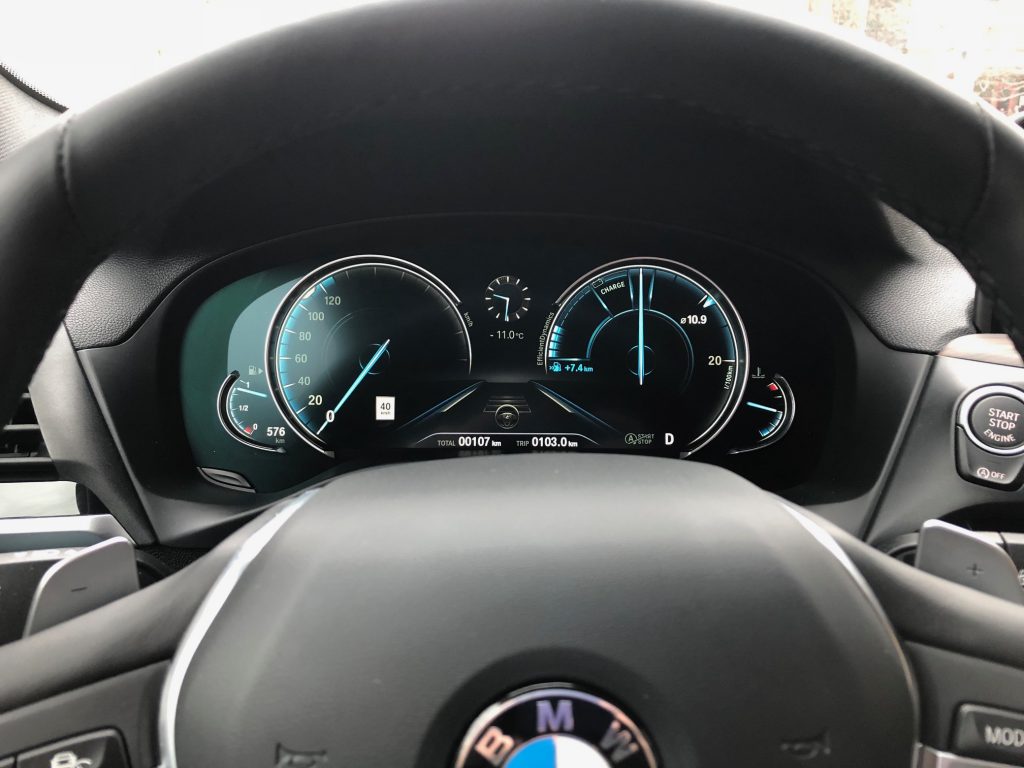
When I specced out our 2018 X3 3.0i SAV, I initially didn’t add the Advanced Driver Assistant Package, but did after thinking that hey, with the biggest vehicle I have ever owned, that Parking Assistant Plus would be a great addition to help out.

It’s been 36 hours since we picked up the X3, also known as Kumakart 2.0, and I’ve not used Parking Assistant Plus – At all.  Yet.  Not for lack of trying either.

No, instead, we’ve been using the part of the package that, while I thought was going to be cool, I had some reservations about.  After 36 hours, I couldn’t be happier.  Seriously.

So what is BMW’s Advanced Driving Assistant Package?  Summed up, autonomous driving with a few buts:

  • Radar cruise control that keeps you 1-4 car lengths away from another car.
  • Steering and Lane Control Assistant – keeping your car in the lane, and it slaps your hand if you don’t use your turn signal.  It also steers around bends automatically.
  • Traffic Jam Assistant – The car will drive in stop & go traffic for you.
  • Active protection – It will ask if you’d like to take a break, tightens seatbelts, automatic breaking in the event of an accident.
  • and a bunch of other services such as Pedestrian Protection, City Collision Mitigation, Frontal Collision Warning,

I’m not planning on getting into an accident, so I can only, really, cover Radar cruise control, steering sand lane control assistant and Traffic Jam Assistant.

All I can say is, wow.  I’m using these systems extensively and way more than I thought.

And know what?  I’m already considerably more relaxed as a driver using these systems.  For example,

  • Set the vehicle to 100 km/h
  • Set the distance to 4 car lengths
  • Drive

If a truck in front of me is doing 90 km/h, the car slows down to match and keep back 4 cars.  If someone moves in to my lane and is moving faster than me, the car  maintains speed. If someone moves into my lane and stays the same speed as me, the car slows down a bit to go back 1 car length or so, and then resumes speed.

If the car recognizes the lines on the road, it will keep me centred in the lane and will also turn with bends in the road – itself.  For this to work, though, you have to touch the steering wheel once every 30 seconds or the system deactivates.  You should still hold on to the steering wheel because sometimes the car just doesn’t see the lines – especially in winter driving conditions.

What was it like to start?

Well, you’re driving a BMW and you want to test what happens when you let go of the steering wheel – AHHHHHHH!  Keep in mind, you have full control, so if you need to correct something, the system defers to the driver.

What I did was turn on the systems and wait for the car to recognize the lines in the road and turn the steering wheel green – This means the car is driving.  I loosened my grip.  What was weird was, to centre, I find the X3 moved to the right in the lane and then corrected itself to the centre.  Although coming back home tonight, I found it moved to the left in the lane and then centred.  It’s a disconcerting feeling at first but once it’s centred it’s pretty good.


Sometimes the clothes do not make the man

I wrote the following a few years ago when George Michael passed away and I found it in my drafts.

George Michael and Andrew Ridgeley nearly ran over my cousin Erika and her friend Sarah in Toronto, during the one and only concert Wham! held in Toronto.  I had forgotten that story and it was the first thing mentioned after breaking the news at Christmas Dinner about George Michael passing.

George Micheal was one of the artists that my cousin Erika and I connected over.  I often listened to her walkman and a tape she had picked up in Korea.

He was quite brilliant.  A vibrant pop act, an amazing voice and gone way to early.

It’s funny reading a friend’s post completely dismissing George Micheal’s music as pop crap.  They really have no idea the power of his music, nor the work he did behind the scenes for people and the world.  Quite an understated force.

Faith, for me, came out at the height of really good pop music in 1987.  The album dripped with sex, romance, love – someone trying to shed their pop roots to become a contemporary serious artist. I am surprised I was even allowed to listen to the album at the age of 13, but hey, I did. It seemed transcend the topic, taking it to a new level.

Listen without prejudice, Vol 1 – Completely changed the George Michael game.  A way more serious album. A completely brilliant, underrated album and a staple of my high school years.  Most notable tracks include Praying for Time, Heal the Pain and Mother’s Pride.

It never bothered me that it took him such a long time to come out as gay.  People do it on their own times. The pressure he was under, everything he dealt with, considering he had lost his first partner to HIV and then his mother in quick succession, it’s not surprising as he had other things to deal with in his life, including Sony and his fight for a new fair contract.

Listening back to Listen without prejudice, Vol 1; it’s not surprising that album spoke volumes to me.

I somewhat lost interest in George Michael after this. Albums such as Older, Songs From The Last Century, and Patience did not resonate with me until more recent times.

When I got on Twitter, I decided to follow George.  I followed, and I found him quite interesting and I enjoyed his banter. I miss his banter these days (updating this post in 2025).

His album Symphonica is amazing. His voice is amazing. I wish I had a chance to see him in concert.

RIP George Michael. You are missed.